
Sanaria Hosts Virtual i-PfSPZ-C Meeting
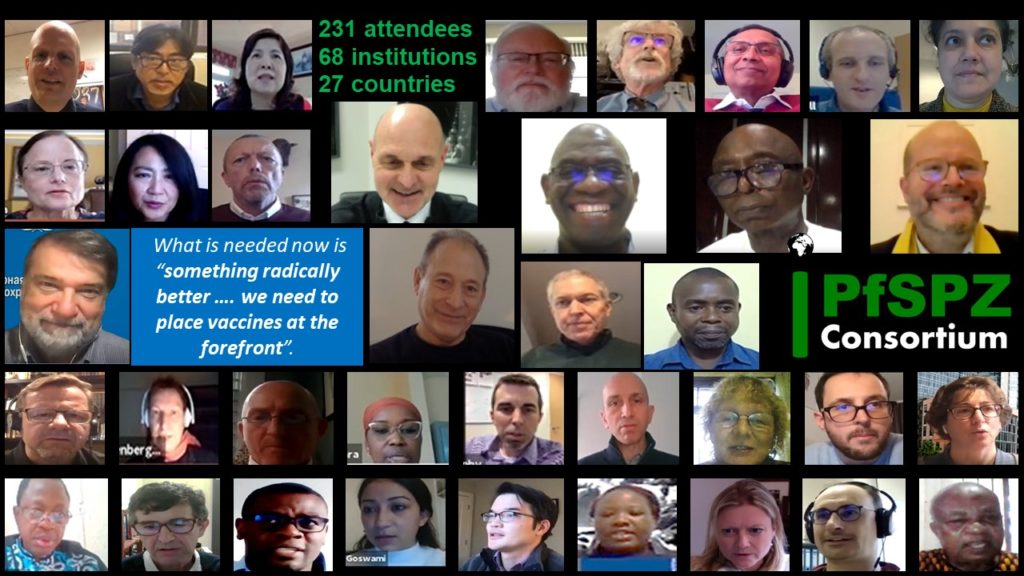
As it has been for so many people, it was impossible for the members of the International PfSPZ Consortium (iPFSPZ-C) to meet face-to-face this year but, undeterred, we moved ahead with a virtual meeting that was hugely successful. During the course of two long sessions on 9th and 10th December, 2020, 231 malaria researchers, regulators and funders from 68 institutions located in 27 different countries met virtually to share plans, insights and data, all aiming to advance the development of whole sporozoite malaria vaccines. Not only was this a record attendance for the iPfSPZ-C, but it was a tribute to the commitment and involvement of so many wonderful collaborators, joining us early in the morning from western USA and staying with us until late at night in Indonesia, or into the evening in Tanzania and Kenya, through all points in Equatorial Guinea, Ghana, Gabon, Mali, Germany, Switzerland and Spain to name but a few. We are so thankful to all for joining this important meeting.
The iPfSPZ-C has become a strong malaria family. We honored Dr. Angelinas Nnang Eyene Nchama (MHSW), one of our Equatoguinean physicians who passed away in 2020 and celebrated Dr. Tobias Schindler (Swiss TPH) for his much deserved recognition as the recipient of the R. Geigy Award 2020. Tobias has been at the core of our efforts in both Tanzania and EG, and all who interact with him are so appreciative of his helpful nature, excellent science and strong work ethic. Throughout the meeting we were supported by many involved critically with progressing the iPFSPZ-C mission. Prof. Peter Kremsner (Tübingen) set the tone for the two days with his insights into the unrivalled, consistent protective efficacy seen during PfSPZ clinical trials and his gratitude for recognition of this by the funding recently provided by the EU Malaria Fund. This was echoed by Dr. Alassane Dicko (ICER-Mali) who emphasized the growth of PfSPZ vaccine research in Mali.
The Minister of Health and Social Welfare (MHSW) for the Government of Equatorial Guinea (EG), Dr. Diosdado Nsue Milang addressed the meeting at the start of day one, acknowledged the core role of the EG Malaria Vaccine Initiative in establishing the Baney Public Health Research Laboratory and developing the infrastructure for clinical trials through testing PfSPZ Vaccine and PfSPZ-CVac, which required the creation of the National Ethical Committee of Equatorial Guinea and a big commitment to training and developing human potential in the country. Such practical outcomes were exemplified by Dr. Max Mpina and Prof. Claudia Daubenberger (Swiss TPH/IHI) the following day when they described the central role of the Baney Laboratory in developing COVID testing in EG, becoming the second WHO certified COVID-19 testing laboratory in Africa.
With this recognition and encouragement, we embarked upon a packed agenda which started with leading the meeting attendees through the “Pathway to licensure for PfSPZ Vaccine.” This first session began with an overview presentation by Dr. Tom Richie (Sanaria) highlighting the iPfSPZ-C’s ultimate objective of developing a highly safe and effective vaccine for mass vaccination programs in sub-Saharan African to achieve regional malaria elimination. He described the proposed pathway to reaching this goal, emphasizing key safety, efficacy and feasibility attributes of PfSPZ Vaccine that should enable rapid progress, and then reviewed Sanaria’s regulatory strategy in the US, EU and African countries and the associated Phase 3 plan. The session continued with presentation of a meta-analysis of PfSPZ Vaccine safety by Dr. Preston Church (Sanaria) and descriptions of two key assays that are supporting the development pathway – an FDA-approved, validated PCR biomarker assay developed by Dr. Sean Murphy (U Washington) and a nearly completed validation of the thick blood smear assay by Dr. Pete Billingsley (Sanaria). Dr. Kim Lee Sim (Sanaria/Protein Potential) described how Sanaria has brought clinical manufacturing of PfSPZ products to Phase 3 compliance, including the development of novel cryovials, Ms. Tooba Murshedkar (Sanaria) reviewed key regulatory achievements with the FDA, Paul Ehrlich Institute and EMA, and Dr. Preston Church(substituting for Dr. Kirsten Lyke, UMB), Prof Peter Kremsner, Dr. Judy Epstein (LMIV) and Dr. Said Jongo (IHI) described the pivotal clinical trials to start in 2021 in the US, EU and Africa that constitute the proposed Phase 3 plan. The second session reviewed active, ongoing, or soon-to-start trials, including a study of the safety and efficacy of vaccinating women with PfSPZ Vaccine in Mali prior to pregnancy, described by Dr. Halimatou Diawara (ICER-Mali), a study of the safety and efficacy of PfSPZ Vaccine in 2-12 year old children in Gabon, presented by Dr. Preston Church (substituting for Dr. Maxime Agnandji, CERMEL), a study of PfSPZ Vaccine and PfSPZ-CVac in Indonesian soldiers, described by Dr. Tom Richie (substituting for Dr. Erni Nelwan, EOCRU), and proposed studies of seasonal vaccination of children in the Sahel, presented by Dr. Steve Hoffman (Sanaria). The third session focused on the enormous progress made in developing a malaria vaccine for women of child bearing potential (WOCB) to end the scourge of pregnancy malaria. This important initiative, led by the Dr. Patrick Duffy (NIH-LMIV) and Dr. Alassane Dicko, addresses a critical, unmet need in women in Africa, and the enthusiasm of the speakers, the audience and several attendees of the recently convened second steering meeting of experts on vaccinating against malaria in pregnancy, was tangible. Dr. Sara Healy (U Nevada) provided an overview, and then Dr. Judy Epstein, Dr. Pete Billingsley, Dr. Halimatou Diawara and Dr. Patrick Duffy summarized key accomplishments, including the recommendations of the second expert meeting, the results of a reproductive toxicology study in rabbits funded by NIH, proposed key outcome measures in pregnant women to anchor the upcoming clinical trials and the proposed clinical development plan.
As would be highlighted the following day by Dr. Pedro Alonso (WHO Global Malaria Programme), the funding for research into new tools for malaria control and development, in particular vaccines, has stalled. We were pleased, though, to be able to welcome current and potential funders to talk briefly to the attendees. Holm Keller (EU Malaria Fund and kENUP), Dr. Lee Hall (DMID, NIAID, NIH), Mitoha Ondo’o Ayekaba (MHSW-EG), and Bonifacio Manguire (Marathon Oil CSR) each highlighted the major commitments that they have made to support the PfSPZ Vaccine development program, and reiterated their continued support, recognizing the complexities and long-term nature of the work involved. Dr. Lee Hall and Dr. Pauline Beattie (EDCTP), followed by Dr. Annie Mo (DMID, NIAID, NIH) on the following day, described current and new funding opportunities that are available to the iPFSPZ-C members to help develop the PfSPZ vaccines to clinical testing and licensure. For the first time the meeting was attended by Prince Ned Nwoko of Nigeria who, through his philanthropic foundation, has established a Malaria Eradication Project and he voiced his interest in supporting the work of the iPfSPZ-C. We thank all of these, and other, partners for their critical involvement and anticipated future support.
Perhaps the most important research tool to emerge from Sanaria’s whole PfSPZ vaccine development efforsts has been the use of infectious, aseptic, cryopreserved injectable PfSPZ, known as PfSPZ Challenge, which has been an enabling technology for controlled human malaria infections (CHMIs) in 7 African and 5 European countries, and at 5 sites in the US. We heard how PfSPZ Challenge is being developed as a surrogate for natural exposure (Dr. Joana Silva, UMB), and for understanding the complexities of naturally acquired immunity to malaria in endemic areas such as Kenya (Dr. Melissa Kapulu, KEMRI-Wellcome), Tanzania (Dr. Tobias Schindler, Swiss TPH) and Gabon (Dr. Matthew McCall, Tübingen/Radboud, Dr. Maxime Agnandji), as well as in malaria-naïve individuals (Carlos Lamsfus Calle, Tübingen). Future developments will include an approved PvSPZ Challenge, progress on which was presented by Dr. Sumana Chakravarty (Sanaria).
PfSPZ Vaccine is not the only therapeutic PfSPZ product in Sanaria’s pipeline. The second day reviewed the present and future of PfSPZ-CVac, genetically attenuated parasite vaccines, and advances in understanding the mechanisms of protective immunity, as well as future perspectives on the application of PfSPZ vaccine to elimination. PfSPZ-CVac approach with pyrimethamine in US (Dr. D. Cook, NIH-LMIV) or Mali (Dr. Issaka Sagara, ICER-Mali) and/orchloroquine (Dr. Rolf Fendel, Tübingen) emphasized the two important positives of the approach – improved protection and reduced cost of goods as 5-10 fold fewer PfSPZ are required; 3 doses have now been shown to confer 100% protective efficacy against heterologous CHMI 12 weeks after last dose of vaccine, a level of protection heretofore never approached. Regimens are being simplified; one way of doing so is to shorten the immunization period to 28 days and another is to use parenteral antimalarials as the drugs, one such candidate being pyronaridine (Dr. Andrea Kreidenweiss, Tübingen). The PfSPZ-CVac approach has so far been restricted to adults but the need to move strategically and carefully towards using PfSPZ-CVac in children was highlighted (Dr. Stephen Hoffman).
While PfSPZ-CVac sets the benchmark for protective efficacy per unit dose, genetic modifications can eliminate the need for a drug partner to such that development in the liver is late arresting but replication competent (LARC) (Dr. Stefan Kappe, Seattle Children’s Hospital), can potentially provide protection against other species (Dr. Blandine Franke-Fayard, LUMC) or target protective T-cell epitopes (Dr. Debrashee Goswami, Seattle Children’s Hospital). The long-term aim of such work would be to include different gene modifications on a genetic background that goes beyond NF54, reflecting the diverse parasites seen in nature, by developing designer hybrid Pf strains (Dr. Kim Lee Sim and Dr. Ashley Vaughan, Seattle Children’s Hospital). In parallel, progress in removing the mosquito from the manufacturing process by culturing PfSPZ in vitro were reviewed with Dr Ashley Vaughan providing some molecular insights into the growth of oocysts while Dr. Abraham Eappen (Sanaria) presented the advances in producing in bioreactors billions of PfSPZ that are infective to human hepatocytes. This work represents the future of nextgen PfSPZ vaccines and their efficient manufacture.
The consistent high protective efficacy of PfSPZ vaccines offers the tantalizing prospect of identifying markers (aCSP-IgA, Dr. Joshua Tan, NIH-NIAID) and mechanisms of protection, and a better understanding of the reasons underpinning the different cellular immune responses in malaria naïve (Dr. Irfan Zaidi, Dr. Robert Morrison, both NIH-LMIV) versus malaria experienced (Prof. Claudia Daubenberger ) individuals versus children in Africa (Dr. Tuan Tran, Indiana University). The “black hole” for understanding pre-erythrocytic immunity against SPZ vaccines is the liver; Dr. Sumana Chakravarty described an animal model of PkSPZ in rhesus macaques which will help address this, and with Dr. Moriya Tsuji (Colombia University) described progress in use of a GMP-manufactured glycolipid adjuvant. Finally, Dr. John Tsang (NIH-NIAID) and Dr. Ken Stuart (Seattle Children’s Hospital) overviewed their deep dives into immune responses using systems immunology approaches.
The long-term goal for all in the iPfSPZ-C is the elimination of malaria with PfSPZ vaccines as the game changing new tool to achieve this. The potential of including PfSPZ Vaccine in a public health elimination approach on Bioko Island, EG was well mapped out by Dr. Salim Abdulla (IHI) and Guillermo Garcia (MCDI), and the current director of IHI, Dr. Honorati Masanja strongly supported similar efforts being made in Tanzania. With Prof. Marcel Tanner (Swiss TPH) texting his support in his absence, the last word was left to Dr. Pedro Alonso, framing his comments in the context of the WHO 2020 World Malaria Report. The current successes in malaria control all stem from the 1990s, when the current tools were developed and implemented, and international political will saw the much needed injection of funds. What is needed now he said is “something radically better …. we need to place vaccines at the forefront”. He pointed out, too, that the rapidity with which the COVID vaccines have been developed and their imminent distribution should offer hope to the consortium members. There may well be a renewed imperative for malaria vaccine research and a removal of barriers toward new cold chains for vaccine distribution. It was gratifying for all the to receive such strong support from the Director of the WHO Global Malaria Programme.