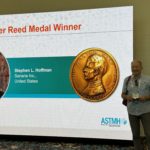
Sanaria and Seattle Children’s Research Institute host the first live i-PfSPZ-C meeting since 2019 in Seattle, WA, USA
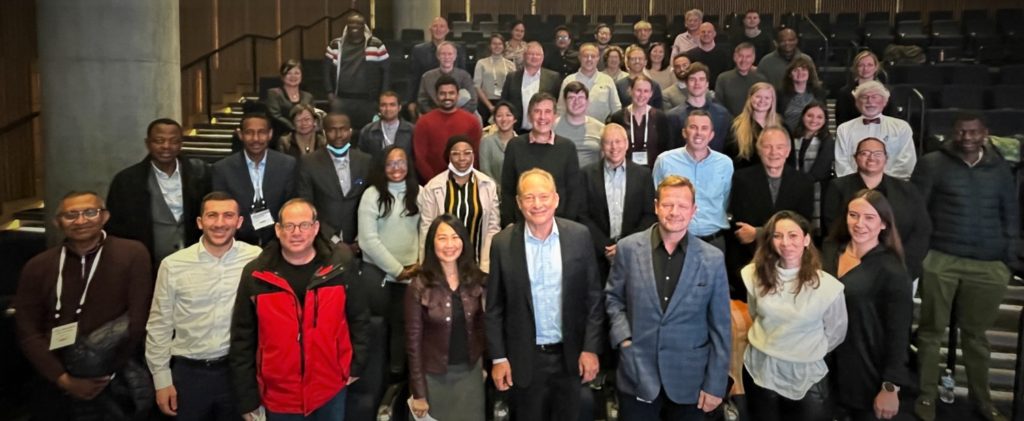
On November 3rd and 4th, 2022, the International PfSPZ Consortium (i-PfSPZ-C) meeting was held as a hybrid event with members joining both virtually and in-person at Seattle Children’s Research Institute’s (SCRI) Building Cure located in downtown Seattle, Washington. We are all grateful to the wonderful hospitality shown by SCRI and for the warm welcome extended by Dr. Eric Tham, Senior Vice President and Chief Research Operations Officer. There were 289 attendees from 86 institutions based in 28 different countries spanning the globe.
The event commenced with a presentation by Dr. Mary Hamel, the World Health Organization (WHO) lead for malaria vaccines, who placed the PfSPZ (Plasmodium falciparum sporozoite) vaccine efforts into the context of the worsening global malaria situation and the recent WHO endorsement of RTS,S/AS01 vaccine to reduce childhood morbidity due to malaria. An overview of PfSPZ vaccines was then provided by Dr. Stephen L. Hoffman (CEO, CSO Sanaria Inc.).
The afternoon continued with a series of presentations on the development of the genetically-modified late arresting replication competent (LARC) PfSPZ vaccines PfSPZ-GA2 and PfSPZ-LARC2. These vaccines have the potential to dramatically improve the efficacy and feasibility of implementing a global malaria vaccination program. Following the initial development pathway of LARC parasites and preclinical animal studies presented by Ashley Vaughan and Stefan Kappe (SCRI), Blandine Franke-Fayard (Leiden University Medical Center[LUMC]) shared her teams stunning protective efficacy results against Controlled Human Malaria Infection (CHMI) with PfSPZ-GA2 (8 of 9 protected) administered by mosquito bite. These were followed by a description of the GMP manufacture of LARC2 (Kim Lee Sim, Sanaria), and the plans for PfSPZ-LARC2 in clinical trials in Tübingen (Andrea Kreidenweiss), Seattle (Sean Murphy, University of Washington), and in women of childbearing potential (WOCBP) and potentially children in Mali (Thomas Richie, Sanaria). The session also included a review of the regulatory aspects of INDs for the genetically-modified vaccines (Tooba Murshedkar, Sanaria) and concluded with a lively discussion moderated by Meta Roestenberg (LUMC), Ashley Vaughan and Pedro Alonso.
Attention then turned towards the use of PfSPZ vaccine in Women of Child Bearing Potential (WOCBP) and pregnancy (Patrick Duffy (Laboratory of Malaria Immunology and Vaccinology[LMIV]) Alassane Diko (University of Bamako), Michael Fried (LMIV), Halimatou Diawara (University Bamako), and Sara Healy (LMIV). A striking feature of the results presented by the team was the protection data in women who subsequently became pregnant, with vaccine efficacy of up to 85% over 2 years without any booster immunization. Immunological studies of the WOCBP trial were presented by Irfan Zaidi (LMIV), and the regulatory and clinical pathways in this demographic were presented by Thomas Richie (Sanaria) and Tooba Murshedkar (Sanaria). The afternoon concluded with reports on the recently completed Warfighter 3 clinical trial by Jim Kublin (SCRI) and progress updates on trials of PfSPZ Vaccine in children in Mali (Issaka Sagara, University of Bamako) and PfSPZ Vaccine and PfSPZ-CVac in Indonesian soldiers (Erni Nelwan, Eijkman-Oxford Clinical Research Unit).
None of the consortium’s current achievements could have been realized without strong funding commitments. The second day kicked off with perspectives on current and future funding directions from Lee Hall and Annie Mo (National Institutes of Health[NIH]), Pauline Beattie (European and Developing Countries Clinical Trials Partnership), Anyaduba Chucks (the Prince Ned Nwoko Malaria Eradication Project), Tahir Gozal (Tahir Gozal Foundation), and Jean-Luc Bodmer (the Bill and Melinda Gates Foundation [BMGF]). This was followed by a session on clinical and parasitological monitoring and endpoints, including presentations and expert panel discussions on qPCR assay validation for clinical trials, how best to use molecular biomarker testing to follow participants in clinical trials and shifting the assessment paradigm from clinical to parasitologic endpoints. Participants included Sean Murphy, Meta Roestenberg (LUMC), Matt Laurens (University of Maryland), Jason Regules (Walter Reed Army Institute of Research), Scott Miller (Bill and Melinda Gates Medical Research Institute), Claudia Daubenberger (Swiss TPH), Albert Lalremruata (University of Tübingen) and Greg Deye’s (NIH). Tobias Schindler (Swiss Tropical and Public Health Institute [Swiss TPH]) presented on a new device for rapid PCR and Max Mpina (Swiss TPH) discussed RDT techniques.
The next session shifted to the breakthrough for manufacturing PfSPZ in vitro (Stephen Hoffman). This was followed by presentations and discussions on improving vaccine efficacy and efficiency with the use of adjuvants (Sumana Chakravarty, Sanaria), prime-boost (Felicia Watson [SCRI] and Sean Murphy), and the generation of genetically-altered vaccine strains and multi-strain vaccines representative of the geographic variants of Pf with presenters from Sanaria (Kim Lee Sim, Ehud Inbar, Bethany Jenkins), SCRI (Ashley Vaughan, Lucia Pazzagli), Univ of Maryland (Joana de Silva), Swiss TPH (Tom Stabler), Plasmodium berghei-based vaccines (Miguel Prudêncio, University of Lisbon), and late liver stage drugs (Justin Boddey, Walter and Eliza Hall Institute of Medical Research).
An exciting complement to malaria vaccines would be the development of a monoclonal antibody that could be easily administered as a single dose, is extremely safe in normal and vulnerable demographics (such as pregnant women, children, or immunocompromised individuals) and highly effective for at least 3 (and preferably 6 to 9) months duration. Our session on monoclonal antibodies (Stephen Hoffman, Peter Crompton, NIH, and Scott Miller, BMGF) presented the most recent stunning protective efficacy data in Mali with with the monoclonal antibody, CIS43LS, which was produced from cells from a subject immunized with PfSPZ Vaccine, and plans for monoclonal antibody development at Sanaria and the Bill and Melinda Gates Medical Research Institute.
In the final sessions of the day, CHMI and immunology were the major topics of discussion. Use of CHMI to discover the antimalarial resistance properties of the Dantu blood group was presented by Silvia Kariuki (Kenya Medical Research Institute[KEMRI]). CHMI is also being used as a tool to study Pf transmission blocking immunity (Melissa Kapulu, KEMRI-Wellcome, Matthew McCall, RUMC and Issaka Sagara, University of Bamako). Nonhuman primate models for P. knowlesi CHMI (Sean Murphy and Melanie Shears, SCRI) and development of PvSPZ Challenge for the study of P. vivax (Sumana Chakravarty, Patrick Duffy and Stefan Kappe) rounded out the discussion. The deep dive into PfSPZ Vaccine immunology and correlates of protection featured presentations from, Jonathan Herman (Ragon Institute), Natasha KC (Sanaria), Irfan Zaidi (NIH-LMIV), Jim Kublin (University of Washington), Ken Stuart (SCRI), Gigi Zanghi (SCRI), Joanna de Silva (University of Maryland) and Tuan Tran (University of Indiana).
As always, the consortium meeting was a highly constructive, interactive and exciting event. Many thanks are accorded to all presenters, moderators, participants, and those who helped in the smooth running of yet another very successful meeting of the International PfSPZ Consortium.